A Horizon 8 pod is a unit of organization determined by Horizon 8 scalability limits. You can create a Horizon 8 pod with a number of building blocks. Each Horizon 8 pod is a unit of management and has a separate console management user interface.
Pod Example Using Two Building Blocks
| Item | Number |
|---|---|
| Building blocks for a Horizon 8 pod | 2 |
| vCenter Server | 2 |
| Database server | 2 (1 standalone database server in each building block) MS SQL Server, Oracle, or PostgreSQL database server |
| Omnissa Horizon Connection Servers | 7 (5 for connections from inside the corporate network and 2 for connections from outside) |
| vLANs | See Horizon 8 Building Blocks. |
| 10Gb Ethernet module | 1 |
| Modular networking switch | 1 |
Depending on the specific configuration, each vCenter Server can support up a large number of virtual machines. This support enables you to have large building blocks of virtual machine desktops. However, the actual block size is also subject to other Horizon-specific limitations.
For both examples described here, a network core can load balance incoming requests across Horizon Connection Server instances. Support for a redundancy and failover mechanism, usually at the network level, can prevent the load balancer from becoming a single point of failure. For example, the Virtual Router Redundancy Protocol (VRRP) can communicate with a load balancer to add redundancy and failover capability.
If a Horizon Connection Server instance fails or becomes unresponsive during an active session, users do not lose data. Desktop states are preserved in the virtual machine desktop so that users can connect to a different Horizon Connection Server instance and their desktop session resumes from where it was when the failure occurred.
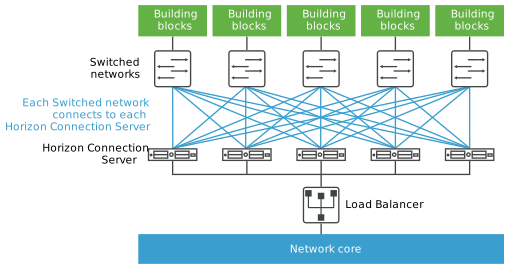
Pod Example Using One vCenter Server
In the previous section, the Horizon 8 pod consisted of multiple building blocks. Each building block supported 5,000 virtual machines with a single vCenter Server. This topic illustrates an architecture based on using a single vCenter Server to manage 10,000 desktops.
Although using one vCenter Server for 10,000 desktops is possible, doing so creates a situation where there is a single point of failure. The loss of that single vCenter Server renders the entire desktop deployment unavailable for power, provisioning, and refit operations. For this reason, choose a deployment architecture that meets your requirements for overall component resiliency.
For this example, a 10,000-user pod consists of physical servers, a vSphere infrastructure, Horizon 8 servers, shared storage, and 5 clusters of 2,000 virtual desktops per cluster.
| Item | Example |
|---|---|
| vSphere clusters | 6 (5 clusters with one instant-clone pool per cluster, and 1 infrastructure cluster) |
| vCenter Server | 1 |
| Database server | 1 (standalone) MS SQL Server, Oracle, or PostgreSQL database server |
| Active Directory server | 1 or 2 |
| Horizon Connection Server instances | 5 |
| Omnissa Unified Access Gateway appliances | 5 |
| vLANs | 8 (5 for the desktop pool clusters, and 1 each for management, VMotion, and the infrastructure cluster) |
Was this page helpful?